DAWTONE diagonal-axis wind turbine
A diagonal-axis wind turbine whose conic geometry was patented in 2022 and turned into a product family rated from 100 W to 5 kW, including a portable variant.
- Role
- Co-Owner & Product Manager; lead microcontroller and embedded engineer on the research grant that produced it
- Organisation
- DAWTONE
- Period
- 2019 – present
- Stage
- Pilot
- Research & method
- Mechanical
- Electronics
- Firmware
- Manufacturing
- Product
PL.01
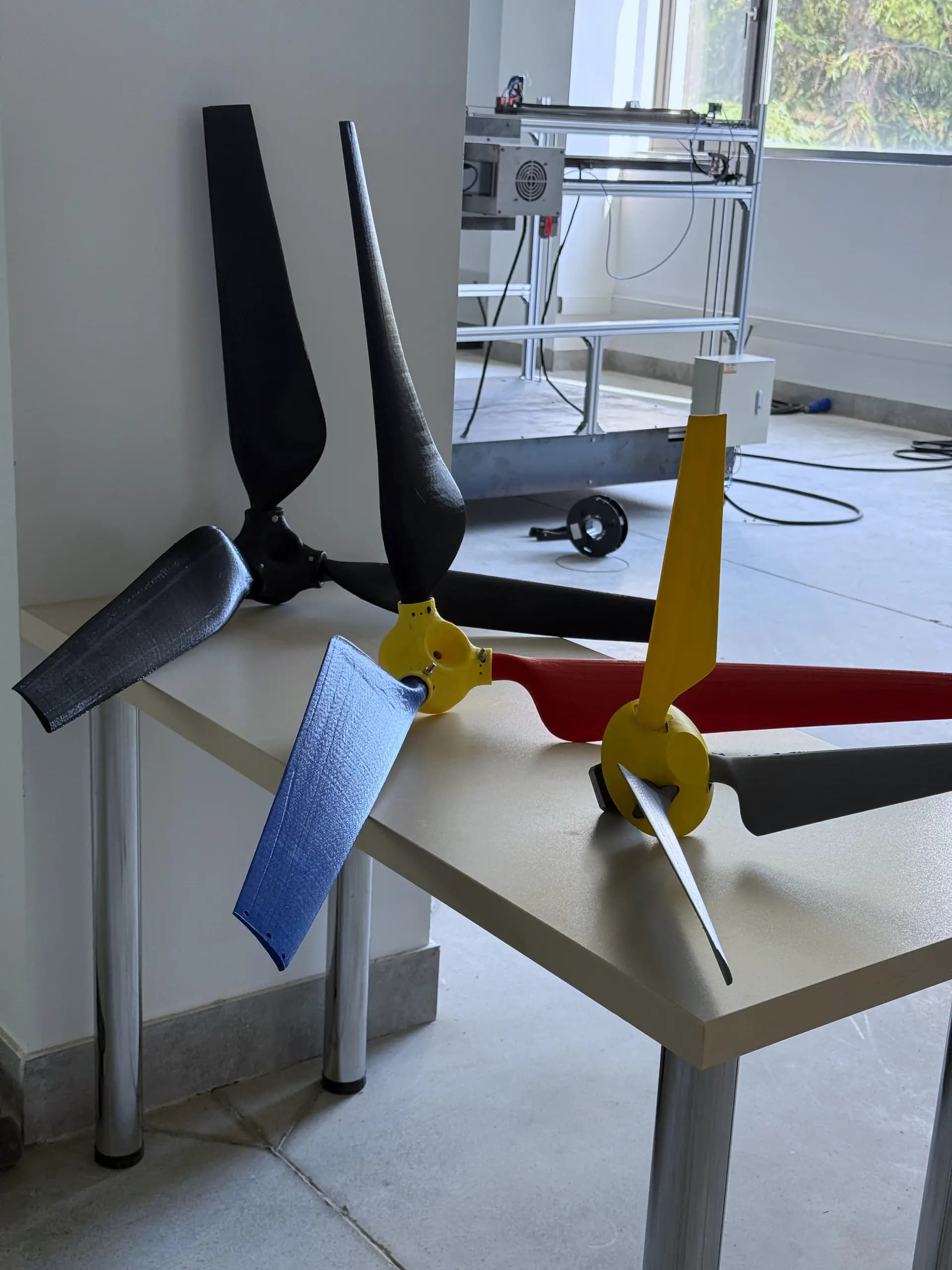
Additively manufactured DAWTONE turbine components.
DAWTONE grew straight out of research I was already doing. A Shota Rustaveli National Science Foundation grant of GEL 550,000, running from 2019, funded research into a new type of conical wind turbine; I was the lead microcontroller and embedded engineer on that team, owning instrumentation, control electronics, data acquisition and firmware. The geometry was filed as a utility model on 16 December 2020 and granted as U 2022 2126 Y, with me a named inventor. The company was founded in January 2023. The product family spans 100 W to 5 kW, including a portable variant, and covers aerodynamic geometry, generator and gearbox selection, power conditioning and control firmware, with blades and structural components manufactured in-house, additively.
The problem
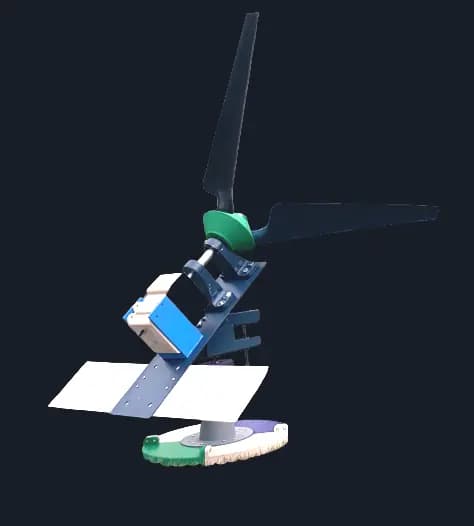
A conventional horizontal-axis turbine has to face the wind. Yawing the machine to chase a shifting wind costs mass, a drive, a control loop and a failure mode, and at the small scales where distributed generation is affordable, those costs dominate the energy budget. A vertical-axis machine avoids yawing but gives much of the wind’s energy back to drag on the returning blade. The conic wheel of U 2022 2126 Y takes a third path: blades fixed to a hub at equal intervals, disposed radially and inclined so that on rotation they write a cut conic surface, with the rotational axis inclined relative to the horizon and a shield shaped as that same conic surface rigidly connected below the wheel. The machine accepts wind from changing directions without turning to meet it.
What was built
- 01
Aerodynamic and structural analysis first: conditions of gradual deflection and equilibrium of the conical turbine, optimisation of the wing-cone angle of attack, and the specifics of aerodynamic equilibrium of a conical drive, published at Georgian Technical University and at the annual conference of the Union of Mechanics of Georgia between 2019 and 2020.
- 02
Then the instrument that proves it: instrumentation, control electronics, data acquisition and firmware on a GEL 550,000 foundation grant, with results presented at ICENTE 2021 and BALTTRIB’2022.
- 03
Magnetic rotational supports and 3D-printed blades, presented at BALTTRIB’2022 at Vytautas Magnus University in Kaunas — additive manufacturing as the manufacturing route for the blades, not as a model-making convenience.
- 04
Automatic blade-angle adjustment, so one geometry covers a range of wind conditions instead of a single design point.
- 05
A product family from 100 W to 5 kW, including a portable variant, with generator and gearbox selection and power conditioning designed around the geometry rather than bought as a kit.
What it produced
Numbers I can stand behind. A number I cannot stand behind is not on this page.
A granted utility model with me a named inventor, a company founded in January 2023 to take it to market, a product family specified from 100 W to 5 kW, and in-house additive manufacturing of blades and structural components. Turbines built, turbines deployed, installed capacity and commercial sales are all owner answers that have not arrived, so not one of them is stated here.
550,000 GEL
Shota Rustaveli Foundation grant that funded the research
Europass CV.pdf — research grant record; research/03-fact-verification-report.md §3.2
100 W
Smallest rating in the product family
Europass CV.pdf — DAWTONE role record (100 W – 5 kW product family)
5,000 W
Largest rating in the product family
Europass CV.pdf — DAWTONE role record (100 W – 5 kW product family)
In pictures
PL.02
DAWTONE product visualisation.
PL.03
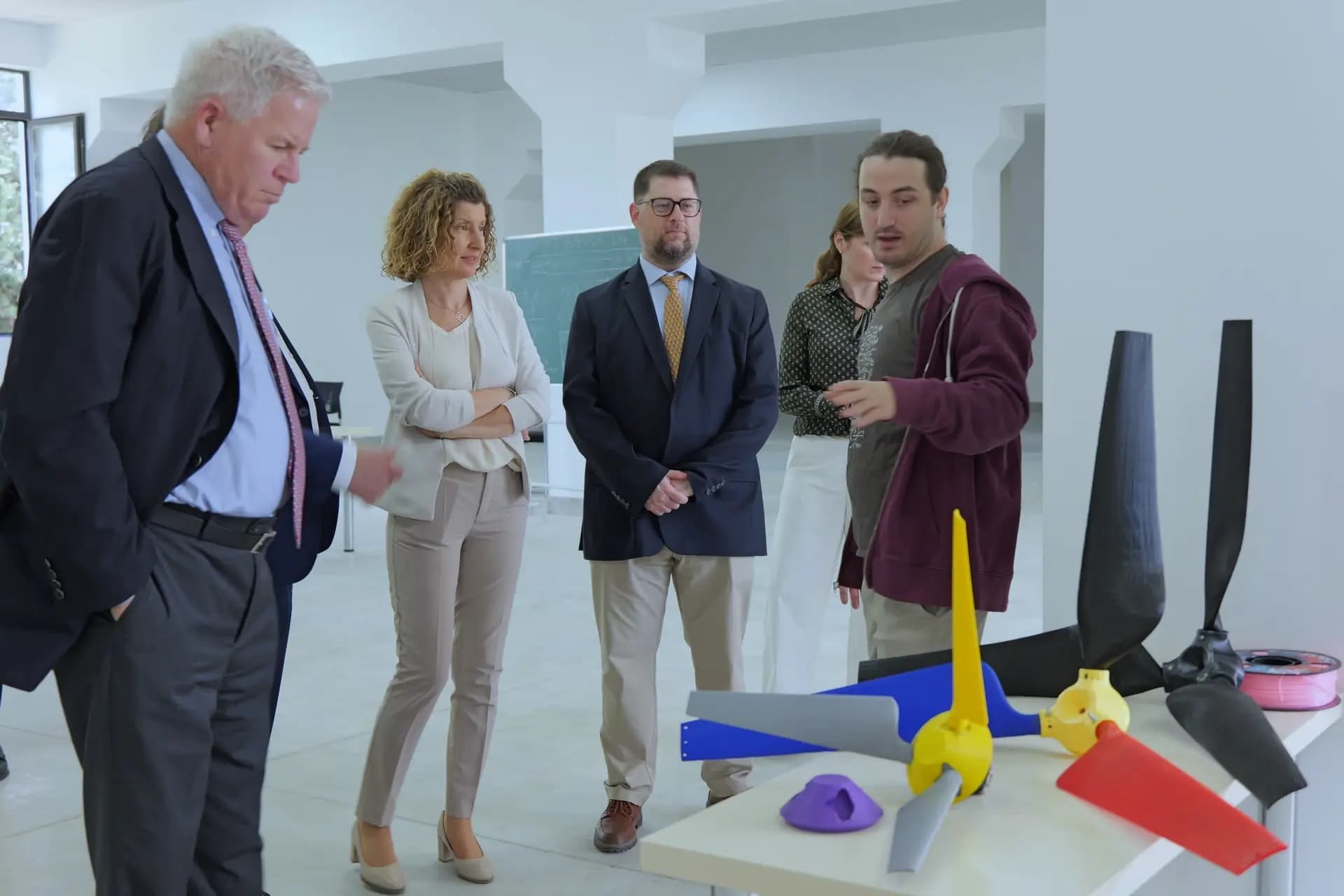
Wind-turbine prototypes discussed with Horizon-related visitors.
Patents
Utility model · U 2022 2126 Y
Conic Wind Wheel
Blades fixed to a hub at equal intervals, disposed radially and inclined, so that on rotation they write a cut conic surface. The rotational axis is inclined relative to the horizon, and a shield shaped as that same cut conic surface is rigidly connected below the wheel. This is the geometry the visitor sees turning on a pole: it accepts wind from changing directions without yawing the machine, and it is the reason DAWTONE exists as a company rather than as a paper.
Filed 16 December 2020 · Granted 10 March 2022 · Archil Geguchadze, Anzori Kuparadze, Nata Sulakvelidze
Funding
2019 · Shota Rustaveli National Science Foundation of Georgia
New Type of Conical Wind Turbine
550,000 GEL
Publications
2024
Diagonal Axis Wind Turbine Design and 3D Printing Technology
— The Internet and Information and Communication Technologies in Today's Society
The other case studies
2022 – present · Production
G3D fused-filament 3D printers
A Georgian manufacturer of fused-filament 3D printers: three production platforms, from a 220 mm desktop machine to a one-metre industrial cell, designed, built and sold out of Tbilisi.
Read the case study →2018 – present · Prototype
Vide
An assistive wearable for blind and low-vision people: multi-point distance sensing, the obstacle classified on the device, directed haptics — deliberately no audio channel and no cloud round-trip.
Read the case study →